参考文献
[1] 邢泉生, 武钦. 心脏间隔缺损生物可降解封堵器的研究进展[J]. 中华胸心血管外科杂志, 2017, 33(6):380‑384. DOI: 10.3760/cma.j.issn.1001‑4497.2017.06.020.
[2] 中国人体健康科技促进会结构性心脏病专业委员会. 生物可降解卵圆孔未闭封堵器临床应用路径中国专家共识[J]. 心脏杂志, 2025, 37(6):621‑629. DOI: 10.12125/j.chj.202504055.
[3] 谢育梅, 陈军. 可降解封堵器治疗先天性心脏病的研究进展[J]. 中华实用儿科临床杂志, 2020, 35(1):2‑6. DOI: 10.3760/cma.j.issn.2095‑428X.2020.01.002.
[4] Shi D, Kang Y, Zhang G, et al. Biodegradable atrial septal defect occluders: a current review[J]. Acta Biomater, 2019,96:68‑80. DOI: 10.1016/j.actbio.2019.05.073.
[5] Capuana E, Lopresti F, Ceraulo M, et al. Poly‑l‑lactic acid (PLLA)‑based biomaterials for regenerative medicine: a review on processing and applications[J]. Polymers (Basel), 2022, 14(6):1153. DOI: 10.3390/polym14061153.
[6] Jinnouchi H, Torii S, Sakamoto A, et al. Fully bioresorbable vascular scaffolds: lessons learned and future directions[J]. Nat Rev Cardiol, 2019, 16(5):286‑304. DOI: 10.1038/s41569‑018‑0124‑7.
[7] Guo G, Hu J, Wang F, et al. A fully degradable transcatheter ventricular septal defect occluder: towards rapid occlusion and post‑regeneration absorption[J]. Biomaterials, 2022,291:121909. DOI: 10.1016/j.biomaterials.2022.121909.
[8] Li B, Xie Z, Wang Q, et al. Biodegradable polymeric occluder for closure of atrial septal defect with interventional treatment of cardiovascular disease[J]. Biomaterials, 2021,274:120851. DOI: 10.1016/j.biomaterials.2021.120851.
[9] Huang S, He P, Xu D, et al. Acidic stress induces apoptosis and inhibits angiogenesis in human bone marrow‑derived endothelial progenitor cells[J]. Oncol Lett, 2017, 14(5):5695‑5702. DOI: 10.3892/ol.2017.6947.
[10] Chen J, Xie Y, Li Y, et al. Assessment of degradability and endothelialization of modified poly L‑lactic acid (PLLA) atrial septal defect (ASD) occluders over time in vivo[J]. J Cardiothorac Surg, 2023, 18(1):283. DOI: 10.1186/s13019‑023‑02401‑3.
[11] Tesfamariam B. Bioresorbable vascular scaffolds: biodegradation, drug delivery and vascular remodeling[J]. Pharmacol Res, 2016,107:163‑171. DOI: 10.1016/j.phrs.2016.03.020.
[12] Faes S, Uldry E, Planche A, et al. Acidic pH reduces VEGF‑mediated endothelial cell responses by downregulation of VEGFR‑2; relevance for anti‑angiogenic therapies[J]. Oncotarget, 2016, 7(52):86026‑86038. DOI: 10.18632/oncotarget.13323.
[13] Wu W, Yip J, Tang YD, et al. A novel biodegradable septal defect occluder: the "Chinese Lantern" design, proof of concept[J]. Innovations (Phila), 2011, 6(4):221‑230. DOI: 10.1097/IMI.0b013e31822a2c42.
[14] Li BN, Xie YM, Xie ZF, et al. Study of biodegradable occluder of atrial septal defect in a porcine model[J]. Catheter Cardiovasc Interv, 2019, 93(1):E38‑45. DOI: 10.1002/ccd.27852.
[15] Matsuzaki Y, Berman DP, Kurobe H, et al. Pre‑clinical evolution of a novel transcatheter bioabsorbable ASD/PFO occluder device[J]. Pediatr Cardiol, 2022, 43(5):986‑994. DOI: 10.1007/s00246‑021‑02809‑5.
[16] 戴柯, 李奋, 孙康, 等. 全生物可降解型房间隔缺损封堵器封堵猪房间隔缺损的实验研究[J]. 临床儿科杂志, 2010, 28(4):375‑379. DOI: 10.3969/j.issn.1000‑3606.2010.04.019.
[17] Wang S, Li Z, Wang Y, et al. Transcatheter closure of perimembranous ventricular septal defect using a novel fully bioabsorbable occluder: multicenter randomized controlled trial[J]. Sci Bull (Beijing), 2023, 68(10):1051‑1059. DOI: 10.1016/j.scib.2023.04.027.
[18] Zhang Q, Zhou J, Zhu S, et al. Safety, effectiveness, and complications of the first‑in‑human minimally invasive transthoracic ventricular septal defect closure using a bioabsorbable occluder: a cohort study with 12‑month follow‑up[J]. Cardiovasc Diagn Ther, 2024, 14(4):630‑641. DOI: 10.21037/cdt‑23‑361.
[19] Li Y, Xie Y, Li B, et al. Initial clinical experience with the biodegradable AbsnowTM device for percutaneous closure of atrial septal defect: a 3‑year follow‑up[J]. J Interv Cardiol, 2021,2021:6369493. DOI: 10.1155/2021/6369493.
[20] Ouyang W, Jiang H, Yan X, et al. Bioresorbable vs metallic occluders for transcatheter atrial septal defect closure: a randomized clinical trial[J/OL]. JAMA, 2025[2026‑06‑01].https://jamanetwork.com/journals/jama/fullarticle/10.1001/jama.2025.17639.DOI: 10.1001/jama.2025.17639.[published online ahead of print October 23,2025].
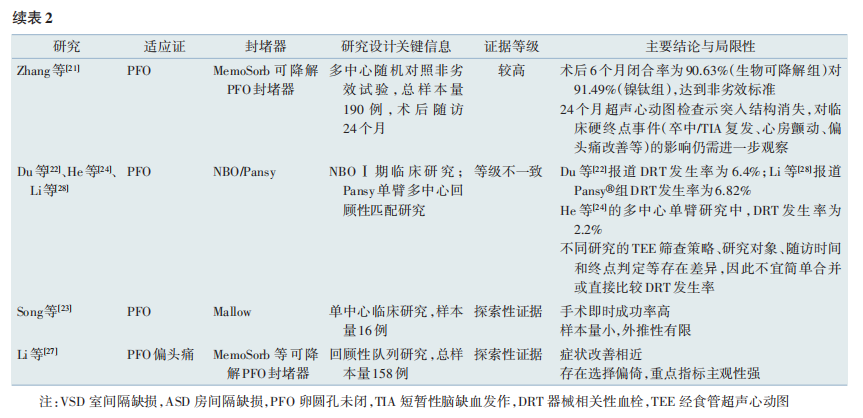
[21] Zhang F, Dong J, Wei P, et al. Transcatheter closure of patent foramen ovale with a novel biodegradable device: a prospective, multicenter, randomized controlled clinical trial[J]. Circulation, 2026, 153(2):71‑81. DOI: 10.1161/CIRCULATIONAHA.125.074609.
[22] Du Y, Xie H, Shao H, et al. A prospective, single‑center, phase Ⅰ clinical trial to evaluate the value of transesophageal echocardiography in the closure of patent foramen ovale with a novel biodegradable occluder[J]. Front Cardiovasc Med, 2022,9:849459. DOI: 10.3389/fcvm.2022.849459.
[23] Song L, Shi P, Zheng X, et al. Echocardiographic characteristics of transcatheter closure of patent foramen ovale with mallow biodegradable occluder: a single‑center, phase Ⅲ clinical study[J]. Front Cardiovasc Med, 2022,9:945275. DOI: 10.3389/fcvm.2022.945275.
[24] He L, Xie H, Gao Y, et al. Biodegradable Pansy® occluder for patent foramen ovale closure: a multicenter, single‑arm, prospective study[J]. Front Cardiovasc Med, 2025,12:1464712. DOI: 10.3389/fcvm.2025.1464712.
[25] Karagianni A, Abrahamsson P, Furenäs E, et al. Closure of persistent foramen ovale with the BioSTAR biodegradable PFO closure device: feasibility and long‑term outcome[J]. Scand Cardiovasc J, 2011, 45(5):267‑272. DOI: 10.3109/14017431.2011.591819.
[26] Li Z, Dong J, Dong J, et al. Comparison of biodegradable and metal occluders in patients with PFO and migraine: study design and rationale of BioMetal Trial[J]. Trials, 2025, 26(1):289. DOI: 10.1186/s13063‑025‑09011‑5.
[27] Li RL, Huang JJ, Ming J, et al. Comparative efficacy and safety of nitinol vs. novel fully biodegradable occluders for transcatheter patent foramen ovale closure in migraine treatment: a retrospective cohort study[J]. Front Med (Lausanne), 2025,12:1613687. DOI: 10.3389/fmed.2025.1613687.
[28] Li B, Zeng H, Xie H, et al. Safety and efficacy of a novel biodegradable occluder‑Pansy® occluder compared with traditional nondegradable occluder in the closure of patent foramen ovale[J]. Front Cardiovasc Med, 2026,13:1704287. DOI: 10.3389/fcvm.2026.1704287.
[29] Mori H, Virmani R, Finn AV. Bioresorbable vascular scaffolds: implication of very late scaffold thrombosis[J]. Coron Artery Dis, 2017, 28(7):533‑538. DOI: 10.1097/MCA.0000000000000518.
[30] 中国医师协会心血管内科医师分会结构性心脏病学组,亚太结构性心脏病俱乐部. 中国经导管二尖瓣缘对缘修复术临床路径(2022全文版)[J/OL]. 中华心血管病杂志(网络版),2023,6:e1000153(2023‑11‑06). http://www.cvjc.org.cn/index.php/Column/columncon/article_id/322. DOI:10.3760/cma.j.cn116031.2023.1000153.