参考文献
[1] Råmunddal T, Hoebers LP, Henriques JP, et al. Chronic total occlusions in Sweden‑‑a report from the Swedish Coronary Angiography and Angioplasty Registry (SCAAR)[J]. PLoS One, 2014,9(8):e103850. DOI: 10.1371/journal.pone.0103850.
[2] Ybarra LF, Rinfret S, Brilakis ES, et al. Definitions and clinical trial design principles for coronary artery chronic total occlusion therapies: CTO‑ARC consensus recommendations[J]. Circulation, 2021,143(5):479‑500. DOI: 10.1161/CIRCULATIONAHA.120.046754.
[3] Lee SW, Lee PH, Ahn JM, et al. Randomized trial evaluating percutaneous coronary intervention for the treatment of chronic total occlusion[J]. Circulation,2019,139(14):1674‑1683. DOI: 10.1161/CIRCULATIONAHA.118.031313.
[4] Werner GS, Martin‑Yuste V, Hildick‑Smith D, et al. A randomized multicentre trial to compare revascularization with optimal medical therapy for the treatment of chronic total coronary occlusions[J]. Eur Heart J, 2018,39(26):2484‑2493. DOI: 10.1093/eurheartj/ehy220.
[5] Sapontis J, Salisbury AC, Yeh RW, et al. Early procedural and health status outcomes after chronic total occlusion angioplasty: a report from the OPEN‑CTO registry (outcomes, patient health status, and efficiency in chronic total occlusion hybrid procedures)[J]. JACC Cardiovasc Interv, 2017,10(15):1523‑1534. DOI: 10.1016/j.jcin.2017.05.065.
[6] Henriques JP, Hoebers LP, Råmunddal T, et al. Percutaneous intervention for concurrent chronic total occlusions in patients with STEMI: the EXPLORE trial[J]. J Am Coll Cardiol, 2016,68(15):1622‑1632. DOI: 10.1016/j.jacc.2016.07.744.
[7] Tong J, Yu Q, Li C, et al. Successful revascularization of noninfarct related artery with chronic total occlusion among acute myocardial infarction patients: a systematic review and meta‑analysis[J]. Medicine (Baltimore), 2018,97(3):e9655. DOI: 10.1097/MD.0000000000009655.
[8] Christakopoulos GE, Christopoulos G, Carlino M, et al. Meta‑analysis of clinical outcomes of patients who underwent percutaneous coronary interventions for chronic total occlusions[J]. Am J Cardiol, 2015,115(10):1367‑1375. DOI: 10.1016/j.amjcard.2015.02.038.
[9] Shaw LJ, Berman DS, Maron DJ, et al. Optimal medical therapy with or without percutaneous coronary intervention to reduce ischemic burden: results from the Clinical Outcomes Utilizing Revascularization and Aggressive Drug Evaluation (COURAGE) trial nuclear substudy[J]. Circulation,2008,117(10):1283‑1291. DOI: 10.1161/CIRCULATIONAHA.107.743963.
[10] Lawton JS, Tamis‑Holland JE, Bangalore S, et al. 2021 ACC/AHA/SCAI guideline for coronary artery revascularization: executive summary: a report of the American College of Cardiology/American Heart Association Joint Committee on Clinical Practice Guidelines[J]. Circulation, 2022,145(3):e4‑e17. DOI: 10.1161/CIR.0000000000001039.
[11] Neumann FJ, Sousa‑Uva M, Ahlsson A, et al. 2018 ESC/EACTS guidelines on myocardial revascularization[J]. Eur Heart J,2019,40(2):87‑165. DOI: 10.1093/eurheartj/ehy394.
[12] Kim RJ, Wu E, Rafael A, et al. The use of contrast‑enhanced magnetic resonance imaging to identify reversible myocardial dysfunction[J]. N Engl J Med, 2000,343(20):1445‑1453. DOI: 10.1056/NEJM200011163432003.
[13] Bucciarelli‑Ducci C, Auger D, Di Mario C, et al. CMR guidance for recanalization of coronary chronic total occlusion[J]. JACC Cardiovasc Imaging, 2016,9(5):547‑556. DOI: 10.1016/j.jcmg.2015.10.025.
[14] Pica S, Di Giovine G, Bollati M, et al. Cardiac magnetic resonance for ischaemia and viability detection. Guiding patient selection to revascularization in coronary chronic total occlusions: the CARISMA_CTO study design[J]. Int J Cardiol, 2018,272:356‑362. DOI: 10.1016/j.ijcard.2018.08.061.
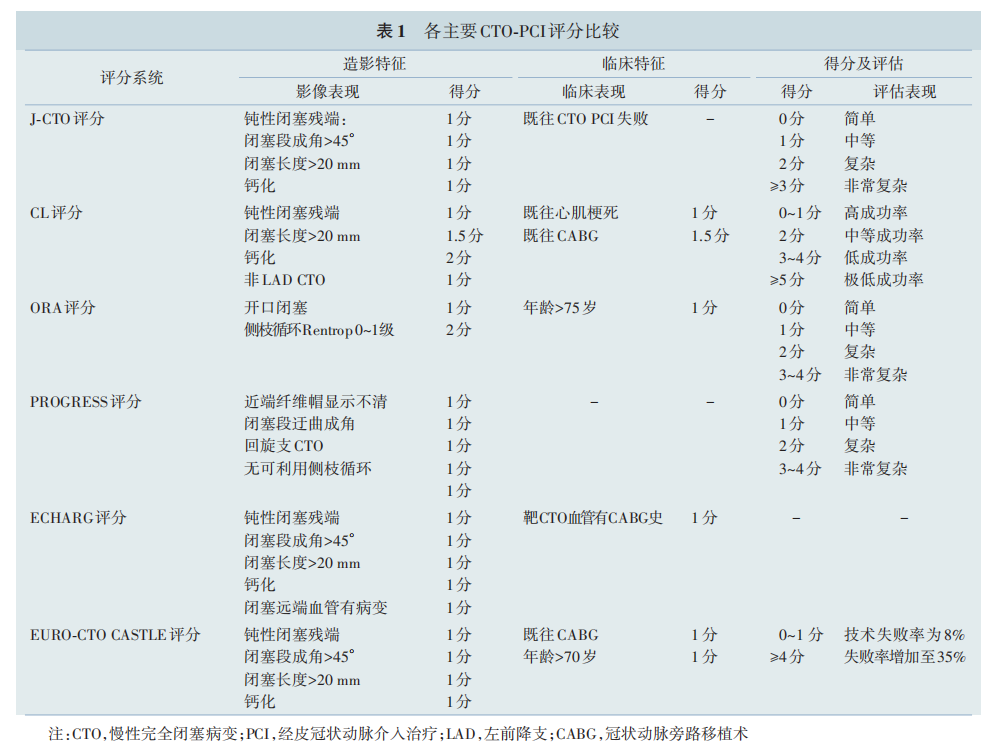
[15] Morino Y, Abe M, Morimoto T, et al. Predicting successful guidewire crossing through chronic total occlusion of native coronary lesions within 30 minutes: the J‑CTO (multicenter CTO registry in Japan) score as a difficulty grading and time assessment tool[J]. JACC Cardiovasc Interv, 2011,4(2):213‑221. DOI: 10.1016/j.jcin.2010.09.024.
[16] Alessandrino G, Chevalier B, Lefèvre T, et al. A clinical and angiographic scoring system to predict the probability of successful first‑attempt percutaneous coronary intervention in patients with total chronic coronary occlusion[J]. JACC Cardiovasc Interv, 2015,8(12):1540‑1548. DOI: 10.1016/j.jcin.2015.07.009.
[17] Christopoulos G, Kandzari DE, Yeh RW, et al. Development and validation of a novel scoring system for predicting technical success of chronic total occlusion percutaneous coronary interventions: the PROGRESS CTO (Prospective Global Registry for the Study of Chronic Total Occlusion Intervention) Score[J]. JACC Cardiovasc Interv, 2016,9(1):1‑9. DOI: 10.1016/j.jcin.2015.09.022.
[18] Galassi AR, Boukhris M, Azzarelli S, et al. Percutaneous coronary revascularization for chronic total occlusions: a novel predictive score of technical failure using advanced technologies[J]. JACC Cardiovasc Interv, 2016,9(9):911‑922. DOI: 10.1016/j.jcin.2016.01.036.
[19] Maeremans J, Walsh S, Knaapen P, et al. The hybrid algorithm for treating chronic total occlusions in Europe: the RECHARGE registry[J]. J Am Coll Cardiol, 2016,68(18):1958‑1970. DOI: 10.1016/j.jacc.2016.08.034.
[20] Szijgyarto Z, Rampat R, Werner GS, et al. Derivation and validation of a chronic total coronary occlusion intervention procedural success score from the 20,000‑patient EuroCTO registry: the EuroCTO (CASTLE) score[J]. JACC Cardiovasc Interv, 2019,12(4):335‑342. DOI: 10.1016/j.jcin.2018.11.020.
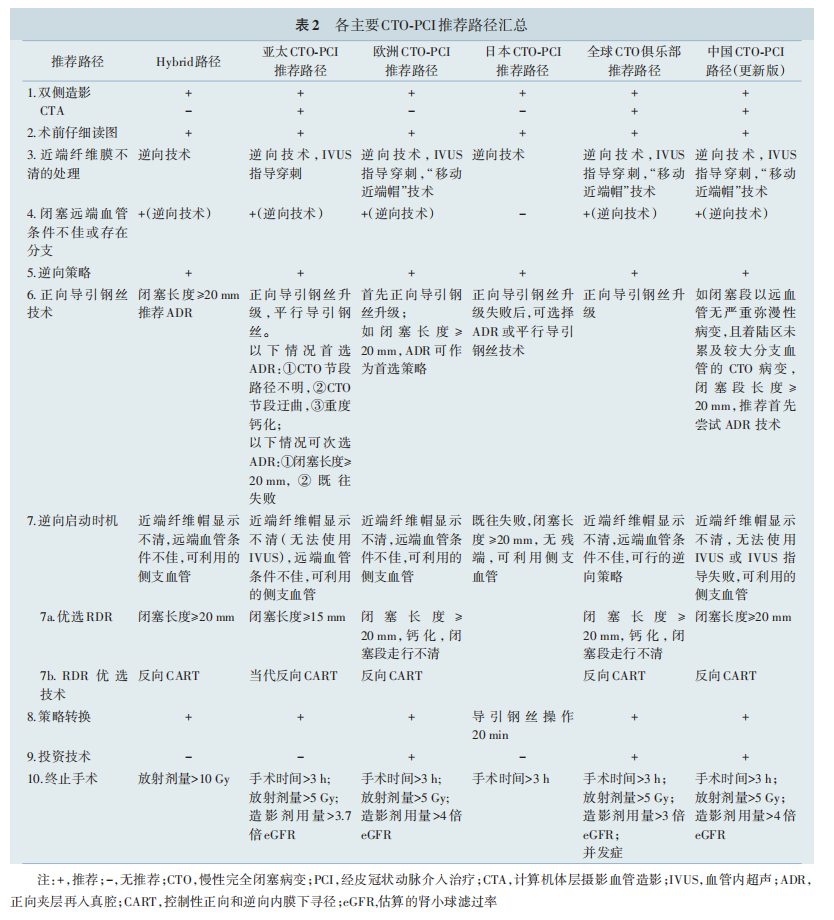
[21] 聂斌 . 双侧造影——冠状动脉慢性闭塞病变介入治疗的基石 [J/OL]. 中华心血管病杂志(网络版),2021,4:e1000088.(2021-10-21)[2022-04-27]. http://www.cvjc.org.cn/index.php/Column/columncon/article_id/264. DOI:10.3760/cma.j.cn116031.2021.1000088.
[22] Brilakis ES, Grantham JA, Rinfret S, et al. A percutaneous treatment algorithm for crossing coronary chronic total occlusions[J]. JACC Cardiovasc Interv, 2012,5(4):367‑379. DOI: 10.1016/j.jcin.2012.02.006.
[23] Harding SA, Wu EB, Lo S, et al. A new algorithm for crossing chronic total occlusions from the Asia Pacific Chronic Total Occlusion Club[J]. JACC Cardiovasc Interv, 2017,10(21):2135‑2143. DOI: 10.1016/j.jcin.2017.06.071.
[24] Galassi AR, Werner GS, Boukhris M, et al. Percutaneous recanalisation of chronic total occlusions: 2019 consensus document from the EuroCTO Club[J]. EuroIntervention, 2019,15(2):198‑208. DOI: 10.4244/EIJ‑D‑18‑00826.
[25] Brilakis ES, Mashayekhi K, Tsuchikane E, et al. Guiding principles for chronic total occlusion percutaneous coronary intervention[J]. Circulation, 2019,140(5):420‑433. DOI: 10.1161/CIRCULATIONAHA.119.039797.
[26] 中国冠状动脉慢性闭塞病变介入治疗俱乐部. 中国冠状动脉慢性完全闭塞病变介入治疗推荐路径[J].中国介入心脏病学杂志,2018,26(3):121‑124. DOI: 10.3969/j.issn.1004‑8812.2018.03.001.
[27] 葛均波, 葛雷, 霍勇, 等. 中国冠状动脉慢性完全闭塞病变介入治疗推荐路径更新[J].中国介入心脏病学杂志,2021,29(6):302‑305. DOI: 10.3969/j.issn.1004‑8812.2021.06.002.