参考文献
[1] Neumann FJ, Sousa-Uva M, Ahlsson A, et al. 2018 ESC/EACTS guidelines on myocardial revascularization[J]. Eur Heart J, 2019,40(2):87-165. DOI: 10.1093/eurheartj/ehy394.
[2] Nabel EG, Braunwald E. A tale of coronary artery disease and myocardial infarction[J]. N Engl J Med, 2012,366(1):54-63. DOI: 10.1056/NEJMra1112570.
[3] Kirchhof P, Ammentorp B, Darius H, et al. Management of atrial fibrillation in seven European countries after the publication of the 2010 ESC Guidelines on atrial fibrillation: primary results of the PREvention oF thromboemolic events�European Registry in Atrial Fibrillation (PREFER in AF)[J]. Europace, 2014,16(1):6-14. DOI: 10.1093/europace/eut263.
[4] 中华心血管病杂志(网络版)编辑委员会 . 口服抗栓药物相关消化道损伤防治专家共识 [J/OL]. 中华心血管病杂志( 网络版 ),2021,4:e1000081.(2021-08-09)[2021-08-09]. http://www.cvjc.org.cn/index.php/Column/columncon/article_id/249. DOI:10.3760/cma.j.cn116031.2021.1000081.
[5] 张敏 . 基于 CYP2C19 基因型和血小板功能的个体化抗血小板治疗对 PCI 患者预后的影响 [D]. 济南:山东大学 , 2020.10.27272/d.cnki.gshdu.2020.000099.
[6] Valgimigli M, Bueno H, Byrne RA, et al. 2017 ESC focused update on dual antiplatelet therapy in coronary artery disease developed in collaboration with EACTS: the Task Force for dual antiplatelet therapy in coronary artery disease of the European Society of Cardiology (ESC) and of the European Association for Cardio-Thoracic Surgery (EACTS)[J]. Eur Heart J, 2018,39(3):213-260. DOI: 10.1093/eurheartj/ehx419.
[7] Schatz RA. A view of vascular stents[J]. Circulation, 1989,79(2):445-457. DOI: 10.1161/01.cir.79.2.445.
[8] Ozaki Y, Garcia-Garcia HM, Shlofmitz E, et al. Second-generation drug-eluting resorbablemagnesium scaffold: review of the clinical evidence[J]. Cardiovasc Revasc Med, 2020,21(1):127-136. DOI: 10.1016/j.carrev.2019.10.012
[9] Lee S, Baek K, Chun K. Cost-effectiveness of drug-eluting vs. bare-metal stents in patients with coronary artery disease from the Korean National Health Insurance Database[J]. Yonsei Med J, 2014,55(6):1533-1541. DOI: 10.3349/ymj.2014.55.6.1533.
[10] Garg S, Bourantas C, Serruys PW. New concepts in the design of drug-eluting coronary stents[J]. Nat Rev Cardiol, 2013,10(5):248-260. DOI: 10.1038/nrcardio.2013.13.
[11] Im E, Hong MK. Drug-eluting stents to prevent stent thrombosis and restenosis[J]. Expert Rev Cardiovasc Ther, 2016,14(1):87-104. DOI: 10.1586/14779072.2016.1112267.
[12] Wiebe J, Nef HM, Hamm CW. Current status of bioresorbable scaffolds in the treatment of coronary artery disease[J]. J Am Coll Cardiol, 2014,64(23):2541-2551. DOI: 10.1016/j.jacc.2014.09.041.
[13] Verdoia M, Khedi E, Suryapranata H, et al. Very short dual antiplatelet therapy after PCI and new DES: a meta-analysis of 5 randomized trials[J]. Rev Esp Cardiol (Engl Ed), 2021,74(2):140-148. DOI: 10.1016/j.rec.2020.03.009.
[14] Garg A, Rout A, Sharma A, et al. Safety and efficacy of antiplatelet regimens after percutaneous coronary intervention using drug eluting stents: a network meta-analysis of randomized controlled trials[J]. Prog Cardiovasc Dis, 2020,63(3):243-248. DOI: 10.1016/j.pcad.2020.03.018.
[15] Yin SH, Xu P, Wang B, et al. Duration of dual antiplatelet therapy after percutaneous coronary intervention with drug�eluting stent: systematic review andnetwork meta-analysis[J]. BMJ, 2019,365:l2222. DOI: 10.1136/bmj.l2222.
[16] Lin BY, Li P, Wu P, et al. Duration of dual antiplatelet therapy and late stent thrombosis following percutaneous coronary intervention with second-generation drug-eluting stents: a simple meta-analysis of randomized controlled trials[J]. Adv Ther, 2019,36(11):3166-3173. DOI: 10.1007/s12325-019-01091-5.
[17] Lee SY, Hong MK, Palmerini T, et al. Short-term versus long-term dual antiplatelet therapy after drug-eluting stent implantation in elderly patients: a meta-analysis of individual participant data from 6 randomized trials[J]. JACC Cardiovasc Interv, 2018,11(5):435-443. DOI: 10.1016/j.jcin.2017.10.015.
[18] Wang W, Liu J, Fang J, et al. The optimal discontinuation of dual antiplatelet therapy in patients undergoing percutaneous coronary intervention with drug-eluting stents: a meta-analysis of randomized trials[J]. Int J Cardiol, 2017,235:73-86. DOI: 10.1016/j.ijcard.2017.02.091.
[19] Ferrante G, Condorelli G, Pagnotta P, et al. Dual antiplatelet therapy continuation beyond 1 year after drug-eluting stents: a meta-analysis of randomized trials[J]. Circ Cardiovasc Interv, 2017,10(5): e004139. DOI: 10.1161/CIRCINTERVENTIONS.116.004139.
[20] D’Ascenzo F, Moretti C, Bianco M, et al. Meta-analysis of the duration of dual antiplatelet therapy in patients treated with second-generation drug-eluting stents[J]. Am J Cardiol, 2016,117(11):1714-1723. DOI: 10.1016/j.amjcard.2016.03.005.
[21] Spencer FA, Prasad M, Vandvik PO, et al. Longer- versus shorter-duration dual-antiplatelet therapy after drug-eluting stent placement: a systematic review and meta-analysis[J]. Ann Intern Med, 2015,163(2):118-126. DOI: 10.7326/M15-0083.
[22] Palmerini T, Sangiorgi D, Valgimigli M, et al. Short- versus long-term dual antiplatelet therapy after drug-eluting stent implantation: an individual patient data pairwise and network meta-analysis[J]. J Am Coll Cardiol, 2015,65(11):1092-1102. DOI: 10.1016/j.jacc.2014.12.046.
[23] Navarese EP, Andreotti F, Schulze V, et al. Optimal duration of dual antiplatelet therapy after percutaneous coronary intervention with drug eluting stents: meta-analysis of randomised controlled trials[J]. BMJ, 2015,350:h1618. DOI: 10.1136/bmj.h1618.
[24] Giustino G, Baber U, Sartori S, et al. Duration of dual antiplatelet therapy after drug-eluting stent implantation: a systematic review and meta-analysis of randomized controlled trials[J]. J Am Coll Cardiol, 2015,65(13):1298-1310. DOI: 10.1016/j.jacc.2015.01.039.
[25] Bulluck H, Kwok CS, Ryding AD, et al. Safety of short-term dual antiplatelet therapy after drug-eluting stents: an updated meta-analysis with direct and adjusted indirect comparison of randomized control trials[J]. Int J Cardiol, 2015,181:331-339. DOI: 10.1016/j.ijcard.2014.12.037.
[26] Cassese S, Byrne RA, Tada T, et al. Clinical impact of extended dual antiplatelet therapy after percutaneous coronary interventions in the drug-eluting stent era: a meta-analysis of randomized trials[J]. Eur Heart J, 2012,33(24):3078-3087. DOI: 10.1093/eurheartj/ehs318.
[27] Takahashi K, Serruys PW, Chichareon P, et al. Efficacy and safety of ticagrelor monotherapy in patients undergoing multivessel PCI[J]. J Am Coll Cardiol, 2019,74(16):2015-2027. DOI: 10.1016/j.jacc.2019.08.997.
[28] Watanabe H, Domei T, Morimoto T, et al. Effect of 1-month dual antiplatelet therapy followed by clopidogrel vs 12-month dual antiplatelet therapy on cardiovascular and bleeding events in patients receiving PCI: the STOPDAPT-2 randomized clinical trial[J]. JAMA, 2019,321(24):2414-2427. DOI: 10.1001/jama.2019.8145.
[29] Vranckx P, Valgimigli M, Jüni P, et al. Ticagrelor plus aspirin for 1 month, followed by ticagrelor monotherapy for 23 months vs aspirin plus clopidogrel or ticagrelor for 12 months, followed by aspirin monotherapy for 12 months after implantation of a drug-eluting stent: a multicentre, open-label, randomised superiority trial[J]. Lancet, 2018,392(10151):940-949. DOI: 10.1016/S0140-6736(18)31858-0.
[30] Nakamura M, Iijima R, Ako J, et al. Dual antiplatelet therapy for 6 versus 18 months after biodegradable polymer drug�eluting stent implantation[J]. JACC,Cardiovasc Interv, 2017,10(12):1189-1198. DOI: 10.1016/j.jcin.2017.04.019.
[31] Hermiller JB, Krucoff MW, Kereiakes DJ, et al. Benefits and risks of extended dual antiplatelet therapy after everolimus�eluting stents[J]. JACC Cardiovasc Interv,2016,9(2):138-147. DOI: 10.1016/j.jcin.2015.10.001.
[32] Han Y, Xu B, Xu K, et al. Six versus 12 months of dual antiplatelet therapy after implantation of biodegradable polymer sirolimus-eluting stent: randomized substudy of the I-LOVE�IT 2 trial[J]. Circ Cardiovasc Interv,2016,9(2):e003145. DOI: 10.1161/CIRCINTERVENTIONS.115.003145.
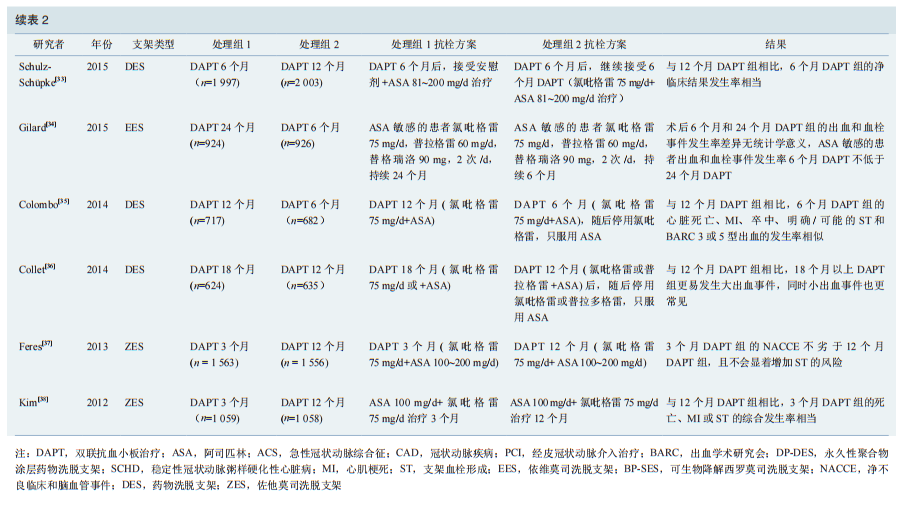
[33] Schulz-Schüpke S, Byrne RA, Ten Berg JM, et al. ISAR-SAFE: a randomized, double-blind, placebo-controlled trial of 6 vs.12 months of clopidogrel therapy after drug-eluting stenting[J]. Eur Heart J, 2015,36(20):1252-1263. DOI: 10.1093/eurheartj/ehu523.
[34] Gilard M, Barragan P, Noryani A, et al. 6- versus 24-month dual antiplatelet therapy after implantation of drug-eluting stents in patients nonresistant to aspirin: the randomized, multicenter ITALIC trial[J]. J Am Coll Cardiol, 2015,65(8):777-786. DOI: 10.1016/j.jacc.2014.11.008.
[35] Colombo A, Chieffo A, Frasheri A, et al. Second-generation drug-eluting stent implantation followed by 6- versus 12-month dual antiplatelet therapy: the SECURITY randomized clinical trial[J]. J Am Coll Cardiol, 2014,64(20):2086-2097. DOI: 10.1016/j.jacc.2014.09.008.
[36] Collet JP, Silvain J, Barthélémy O, et al. Dual-antiplatelet treatment beyond 1 year after drug-eluting stent implantation (ARCTIC-Interruption): a randomised trial[J]. Lancet, 2014,384(9954):1577-1585. DOI: 10.1016/S0140-6736(14)60612-7.
[37] Feres F, Costa RA, Abizaid A, et al. Three vs twelve months of dual antiplatelet therapy after zotarolimus-eluting stents: the OPTIMIZE randomized trial[J]. JAMA, 2013,310(23):2510-2522. DOI: 10.1001/jama.2013.282183.
[38] Kim BK, Hong MK, Shin DH, et al. A new strategy for discontinuation of dual antiplatelet therapy: the RESET Trial (REal Safety and Efficacy of 3-month dual antiplatelet Therapy following Endeavor zotarolimus-eluting stent implantation)
[J]. J Am Coll Cardiol, 2012,60(15):1340-1348. DOI: 10.1016/j.jacc.2012.06.043.
[39] Levine GN, Bates ER, Blankenship JC, et al. 2011 ACCF/AHA/SCAI Guideline for percutaneous coronary intervention: a report of the American College of Cardiology Foundation/American Heart Association Task Force on Practice Guidelines and the Society for Cardiovascular Angiography and Interventions[J]. Circulation, 2011,124(23):e574-e651. DOI: 10.1161/CIR.0b013e31823ba622.
[40] Grines CL, Bonow RO, Casey DE Jr, et al. Prevention of premature discontinuation of dual antiplatelet therapy in patients with coronary artery stents: a science advisory from the American Heart Association, American College of Cardiology, Society for Cardiovascular Angiography and Interventions, American College of Surgeons, and American Dental Association, with representation from the American College of Physicians[J]. Catheter Cardiovasc Interv, 2007,69(3):334-340. DOI: 10.1002/ccd.21124.
[41] Vandvik PO, Lincoff AM, Gore JM, et al. Primary and secondary prevention of cardiovascular disease: antithrombotic Therapy and Prevention of Thrombosis, 9th ed: American College of Chest Physicians Evidence-Based Clinical Practice Guidelines[J]. Chest, 2012,141(2 Suppl):e637S-e668S. DOI: 10.1378/chest.11-2306.
[42] Yusuf S, Zhao F, Mehta SR, et al. Effects of clopidogrel in addition to aspirin in patients with acute coronary syndromes without ST-segment elevation[J]. N Engl J Med, 2001,345(7):494-502. DOI: 10.1056/NEJMoa010746.
[43] Wiviott SD, Braunwald E, McCabe CH, et al. Prasugrel versus clopidogrel in patients with acute coronary syndromes[J]. N Engl J Med, 2007,357(20):2001-2015. DOI: 10.1056/NEJMoa0706482.
[44] Wallentin L, Becker RC, Budaj A, et al. Ticagrelor versus clopidogrel in patients with acute coronary syndromes[J]. N Engl J Med, 2009,361(11):1045-1057. DOI: 10.1056/NEJMoa0904327.
[45] Park SJ, Park DW, Kim YH, et al. Duration of dual antiplatelet therapy after implantation of drug-eluting stents[J]. N Engl J Med, 2010,362(15):1374-1382. DOI: 10.1056/NEJMoa1001266.
[46] Kandzari DE, Barker CS, Leon MB, et al. Dual antiplatelet therapy duration and clinical outcomes following treatment with zotarolimus-eluting stents[J]. JACC Cardiovasc Interv, 2011,4(10):1119-1128. DOI: 10.1016/j.jcin.2011.06.017.
[47] Kedhi E, Stone GW, Kereiakes DJ, et al. Stent thrombosis: insights on outcomes, predictors and impact of dual antiplatelet therapy interruption from the SPIRIT II, SPIRIT III, SPIRIT IV and COMPARE trials[J]. EuroIntervention, 2012,8(5):599-606. DOI: 10.4244/EIJV8I5A92.
[48] Campo G, Tebaldi M, Vranckx P, et al. Short- versus long-term duration of dual antiplatelet therapy in patients treated for in�stent restenosis: a PRODIGY trial substudy (Prolonging Dual Antiplatelet Treatment After Grading Stent-Induced Intimal Hyperplasia)[J]. J Am Coll Cardiol, 2014,63(6):506-512. DOI: 10.1016/j.jacc.2013.09.043.
[49] Kereiakes DJ. The myths of the bare-metal stent[J]. JAMA Cardiol, 2018,3(11):1039-1040. DOI: 10.1001/jamacardio.2018.3573.
[50] Canadian Agency for Drugs and Technologies in Health. Bioabsorbable stents for adults with coronary artery disease: a review of the clinical effectiveness, cost-effectiveness, and guidelines[M/OL]//Canadian Agency for Drugs and Technologies in Health.CADTH Rapid Response Report. Ottawa (ON): Canadian Agency for Drugs and Technologies in Health,2013[2021-05-11]. https://www.ncbi.nlm.nih.gov/books/NBK195781.
[51] Smith SC Jr, Feldman TE, Hirshfeld JW Jr, et al. ACC/AHA/SCAI 2005 guideline update for percutaneous coronary intervention-summary article: a report of the American College of Cardiology/American Heart Association Task Force on Practice Guidelines (ACC/AHA/SCAI Writing Committee to update the 2001 guidelines for percutaneous coronary intervention)[J]. J Am Coll Cardiol, 2006,47(1):216-235. DOI: 10.1016/j.jacc.2005.11.025.
[52] King SB 3rd, Smith SC Jr, Hirshfeld JW Jr, et al. 2007 focused update of the ACC/AHA/SCAI 2005 guideline update for percutaneous coronary intervention: a report of the American College of Cardiology/American Heart Association Task Force on Practice Guidelines: 2007 writing group to review new evidence and update the ACC/AHA/SCAI 2005 guideline update for percutaneous coronary intervention, writing on behalf of the 2005 writing committee[J]. Circulation, 2008,117(2):261-295. DOI: 10.1161/CIRCULATIONAHA.107.188208.
[53] Ibánez B, James S, Agewall S, et al. 2017 ESC guidelines for the management of acute myocardial infarction in patients presenting with ST-segment elevation[J]. Rev Esp Cardiol (Engl Ed), 2017, 70(12):1082. DOI: 10.1016/j.rec.2017.11.010.
[54] Palmerini T, Benedetto U, Bacchi-Reggiani L, et al. Mortality in patients treated with extended duration dual antiplatelet therapy after drug-eluting stent implantation: a pairwise and Bayesian network meta-analysis of randomised trials[J]. Lancet, 2015,385(9985):2371-2382. DOI: 10.1016/S0140-6736(15)60263-X.
[55] Généreux P, Rutledge DR, Palmerini T, et al. Stent thrombosis and dual antiplatelet therapy interruption with everolimus-eluting stents: insights from the xience coronary stent system trials[J]. Circ Cardiovasc Interv, 2015,8(5): e001362.DOI: 10.1161/CIRCINTERVENTIONS.114.001362.
[56] Mauri L, Kereiakes DJ, Yeh RW, et al. Twelve or 30 months of dual antiplatelet therapy after drug-eluting stents[J]. N Engl J Med, 2014,371(23):2155-2166. DOI: 10.1056/NEJMoa1409312.
[57] 侯雪娜 , 耿巍 , 赵琳 , 等 . 新一代药物洗脱支架植入术后短期与长期双联抗血小板治疗的安全性及有效性的 Meta 分 析 [J]. 中国循证心血管医学杂志,2021,13(3):280-285.DOI: 10.3969/j.issn.1674-4055.2021.03.05.
[58] Tarantini G, Nai Fovino L, Tellaroli P, et al. Optimal duration of dual antiplatelet therapy after second-generation drug-eluting stent implantation in patients with diabetes: the SECURITY (second-generation drug-eluting stent implantation followed by six- versus twelve-month dual antiplatelet therapy)-diabetes substudy[J]. Int J Cardiol, 2016,207:168-176. DOI: 10.1016/j.ijcard.2016.01.068.
[59] Didier R, Morice MC, Barragan P, et al. 6- versus 24-month dual antiplatelet therapy after implantation of drug�eluting stents in patients nonresistant to aspirin: final results of the ITALIC Trial (is there a life for DES after discontinuation of clopidogrel)[J]. JACC Cardiovasc Interv, 2017,10(12):1202-1210. DOI: 10.1016/j.jcin.2017.03.049.
[60] Otsuka F, Vorpahl M, Nakano M, et al. Pathology of second-generation everolimus-eluting stents versus first-generation sirolimus- and paclitaxel-eluting stents in humans[J]. Circulation,2014,129(2):211-223. DOI: 10.1161/CIRCULATIONAHA.113.001790.
[61] Gutiérrez-Chico JL, van Geuns RJ, Regar E, et al. Tissue coverage of a hydrophilic polymer-coated zotarolimus-eluting stent vs. a fluoropolymer-coated everolimus-eluting stent at 13-month follow-up: an optical coherence tomography substudy from the RESOLUTE All Comers trial[J]. Eur Heart J, 2011,32(19):2454-2463. DOI: 10.1093/eurheartj/ehr182.
[62] Hasebe T, Yohena S, Kamijo A, et al. Fluorine doping into diamond-like carbon coatings inhibits protein adsorption and platelet activation[J]. J Biomed Mater Res A, 2007,83(4):1192-1199. DOI: 10.1002/jbm.a.31340.
[63] Kobayashi T, Sotomi Y, Suzuki S, et al. Five-year clinical efficacy and safety of contemporary thin-strut biodegradable polymer versus durable polymer drug-eluting stents: a systematic review and meta-analysis of 9 randomized controlled trials[J]. Cardiovasc Interv Ther, 2020,35(3):250-258. DOI: 10.1007/s12928-019-00613-w.
[64] Roth C, Gangl C, Dalos D, et al. Incidence of late-acquired stent malapposition of drug eluting stents with second generation permanent and biodegradable polymer coatings-A prospective, randomized comparison using optical coherence tomography[J]. J Interv Cardiol, 2018,31(6):780-791. DOI: 10.1111/joic.12572.
[65] Levine GN, Bates ER, Bittl JA, et al. 2016 ACC/AHA guideline focused update on duration of dual antiplatelet therapy in patients with coronary artery disease: a report of the American College of Cardiology/American Heart Association Task Force on Clinical Practice Guidelines[J]. J Thorac Cardiovasc Surg, 2016,152(5):1243-1275. DOI: 10.1016/j.jtcvs.2016.07.044.
[66] Authors/Task Force members, Windecker S, Kolh P, et al. 2014 ESC/EACTS guidelines on myocardial revascularization: the Task Force on Myocardial Revascularization of the European Society of Cardiology (ESC) and the European Association for Cardio-Thoracic Surgery (EACTS)developed with the special contribution of the European Association of Percutaneous Cardiovascular Interventions (EAPCI)[J]. Eur Heart J, 2014,35(37):2541-2619. DOI: 10.1093/eurheartj/ehu278.
[67] Chiabrando JG, Vescovo GM, Del Buono MG, et al. Optimal stent design for high bleeding risk patients: evidence from a network meta-analysis[J]. J Invasive Cardiol, 2021,33(3):E182-E190.
[68] Garot P, Morice MC, Tresukosol D, et al. 2-year outcomes of high bleeding risk patients after polymer-free drug-coated stents[J]. J Am Coll Cardiol, 2017,69(2):162-171. DOI: 10.1016/j.jacc.2016.10.009.
[69] Kinnaird T, Abdul F, Hailan A, et al. Twelve-month outcomes of patients unsuitable for prolonged DAPT presenting with an acute coronary syndrome and treated with polymer-free biolimus A9 drug-coated stents[J]. Catheter Cardiovasc Interv, 2018,92(7):1220-1228. DOI: 10.1002/ccd.27722.
[70] Panchal HB, Daggubati R, Zhao D, et al. Polymer-free drug�coated coronary stents in patientswith stable coronary artery disease at high bleeding risk[J]. Curr Cardiol Rep, 2017,19(2):12. DOI: 10.1007/s11886-017-0819-0.
[71] Hytönen JP, Taavitsainen J, Tarvainen S, et al. Biodegradable coronary scaffolds: their future and clinical and technological challenges[J]. Cardiovasc Res, 2018,114(8):1063-1072. DOI: 10.1093/cvr/cvy097.
[72] Ormiston JA, Serruys PW, Regar E, et al. A bioabsorbable everolimus-eluting coronary stent system for patients with single de-novo coronary artery lesions (ABSORB): a prospective open-label trial[J]. Lancet, 2008,371(9616):899-907. DOI: 10.1016/S0140-6736(08)60415-8.
[73] Kalra A, Rehman H, Khera S, et al. New-generation coronary stents: current data and future directions[J]. Curr Atheroscler Rep, 2017,19(3):14. DOI: 10.1007/s11883-017-0654-1.
[74] Rossini R, Tarantini G, Musumeci G, et al. A multidisciplinary approach on the perioperative antithrombotic management of patients with coronary stents undergoing surgery: surgery after stenting 2[J]. JACC Cardiovasc Interv, 2018,11(5):417-434. DOI: 10.1016/j.jcin.2017.10.051.
[75] Capodanno D, Angiolillo DJ. Antiplatelet therapy after implantation of bioresorbable vascular scaffolds: a review of the published data, practical recommendations, and future directions[J]. JACC Cardiovasc Interv, 2017,10(5):425-437. DOI: 10.1016/j.jcin.2016.12.279.
[76] Díaz JF, Camacho S. Magmaris resorbable magnesium scaffolds: are they here to stay?[J]. Rev Port Cardiol (Engl Ed), 2020,39(8):427-429. DOI: 10.1016/j.repc.2020.07.003.
[77] Haude M, Ince H, Kische S, et al. Safety and clinical performance of a drug eluting absorbable metal scaffold in the treatment of subjects with de novo lesions in native coronary arteries: pooled 12-month outcomes of BIOSOLVE-Ⅱ and BIOSOLVE-Ⅲ[J]. Catheter Cardiovasc Interv, 2018,92(7):E502-E511. DOI: 10.1002/ccd.27680.
[78] Haude M, Ince H, Kische S, et al. Sustained safety and clinical performance of a drug-eluting absorbable metal scaffold up to 24 months: pooled outcomes of BIOSOLVE-Ⅱ and BIOSOLVE-Ⅲ[J]. Euro Intervention, 2017,13(4):432-439. DOI: 10.4244/EIJ-D-17-00254.
[79] Marynissen T, McCutcheon K, Bennett J. Early collapse causing stenosis in a resorbable magnesium scaffold[J]. Catheter Cardiovasc Interv, 2018,92(2):310-312. DOI: 10.1002/ccd.27676.
[80] Barkholt TØ, Neghabat O, Terkelsen CJ, et al. Restenosis in a collapsed magnesium Bioresorbable Scaffold[J]. Circ Cardiovasc Interv, 2017,10(10):e005677. DOI: 10.1161/CIRCINTERVENTIONS.117.005677.