参考文献
[1] Bainey KR, Kaul P, Armstrong PW, et al. Hospital variation in treatment and outcomes in acute coronary syndromes: insights from the alberta contemporary acute coronary syndrome patients invasive treatment strategies (COAPT) study[J]. Int J Cardiol, 2017,241:70-75. DOI: 10.1016/j.ijcard.2017.04.109.
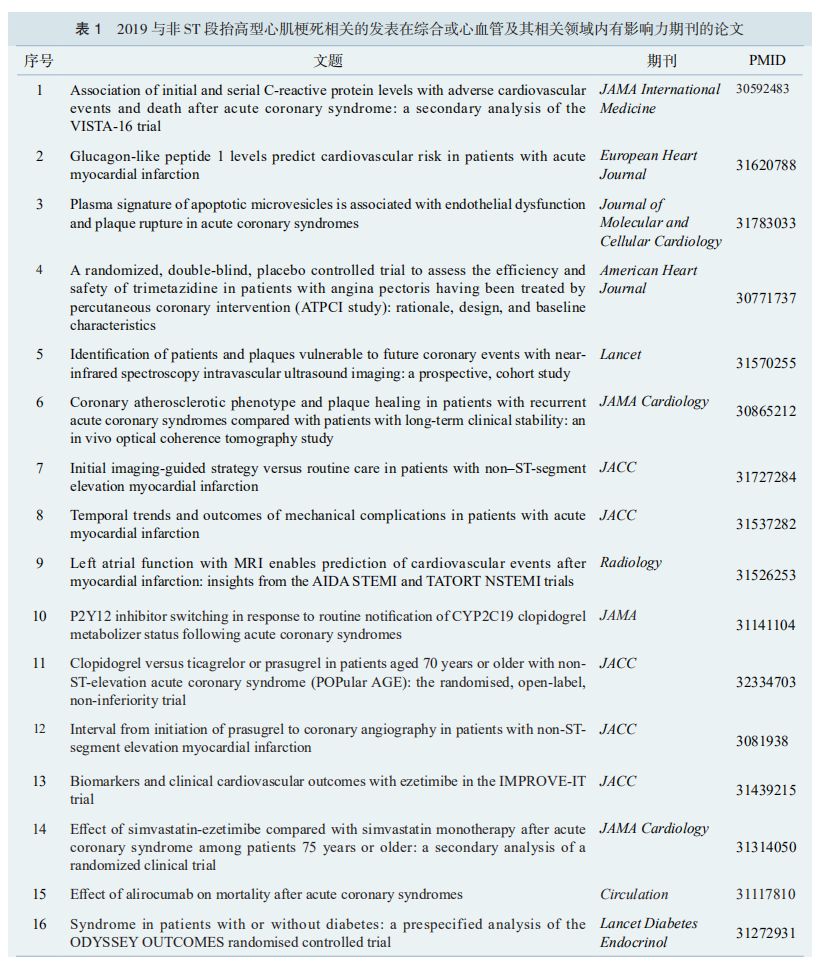
[2] Mani P, Puri R, Schwartz GG, et al. Association of initial and serial C-reactive protein levels with adverse cardiovascular events and death after acute coronary syndrome: a secondary analysis of the VISTA-16 trial[J]. JAMA Cardiol, 2019,4(4):314-320. DOI: 10.1001/jamacardio.2019.0179.
[3] Drucker DJ. Mechanisms of action and therapeutic application of glucagon-like peptide-1[J]. Cell Metab, 2018,27(4):740-756. DOI: 10.1016/j.cmet.2018.03.001.
[4] Kahles F, Rückbeil MV, Mertens RW, et al. Glucagon-like peptide 1 levels predict cardiovascular risk in patients with acute myocardial infarction[J]. Eur Heart J, 2020,41(7):882-889. DOI: 10.1093/eurheartj/ehz728.
[5] Diebold S, Moellmann J, Kahles F, et al. Myocardial infarction is sufficient to increase GLP-1 secretion, leading to improved left ventricular contractility and mitochondrial respiratory capacity[J]. Diabetes Obes Metab, 2018,20(12):2911-2918. DOI: 10.1111/dom.13472.
[6] Lebherz C, Kahles F, Piotrowski K, et al. Interleukin-6 predicts inflammation-induced increase of Glucagon-like peptide-1 in humans in response to cardiac surgery with association to parameters of glucose metabolism[J]. Cardiovasc Diabetol, 2016,15:21. DOI: 10.1186/s12933-016-0330-8.
[7] Hargett LA, Bauer NN. On the origin of microparticles: from “platelet dust” to mediators of intercellular communication[J]. Pulm Circ, 2013,3(2):329-340. DOI: 10.4103/2045-8932. 114760.
[8] Antonopoulos AS, Latsios G, Oikonomou E, et al. Long-term endothelial dysfunction after trans-radial catheterization: A meta-analytic approach[J]. J Card Surg, 2017,32(8):464-473. DOI: 10.1111/jocs.13181.
[9] Nagatomo Y, Li D, Kirsop J, et al. Autoantibodies specifically against β1 adrenergic receptors and adverse clinical outcome in patients with chronic systolic heart failure in the β-blocker era: theimportance of immunoglobulin G3 subclass[J]. J Card Fail, 2016,22(6):417-422. DOI:10.1016/j.cardfail.2016.03.005.
[10] Wang L, Bi Y, Cao M, et al. Microparticles and blood cells induce procoagulant activity via phosphatidylserine exposure in NSTEMI patients following stent implantation[J]. Int J Cardiol,2016,223:121-128. DOI: 10.1016/j.ijcard.2016.07.260.
[11] Zacharia E, Antonopoulos AS, Oikonomou E, et al. Plasma signature of apoptotic microvesicles is associated with endothelial dysfunction and plaque rupture in acute coronary syndromes[J]. J Mol Cell Cardiol, 2020,138:110-114. DOI: 10.1016/j.yjmcc.2019.11.153.
[12] Cabral-Marques O, Marques A, Giil LM, et al. GPCR-specific autoantibody signatures are associated with physiological and pathological immune homeostasis[J]. Nat Commun, 2018,9(1):5224. DOI: 10.1038/s41467-018-07598-9.
[13] Ernst D, Widera C, Weiberg D, et al. Beta-1-adrenergic receptor antibodies in acute coronary syndrome: is less sometimes more?[J]. Front Cardiovasc Med, 2018,5:170. DOI: 10.3389/fcvm.2018.00170.
[14] Ernst D, Westerbergh J, Sogkas G, et al. Lowered anti-beta1 adrenergic receptor antibody concentrations may have prognostic significance in acute coronary syndrome[J]. Sci Rep, 2019,9(1):14552. DOI: 10.1038/s41598-019-51125-9.
[15] Kaura A, Panoulas V, Glampson B, et al. Association of troponin level and age with mortality in 250 000 patients: cohort study across five UK acute care centres[J]. BMJ, 2019,367:l6055. DOI: 10.1136/bmj.l6055.
[16] Ferrari R, Ford I, Fox K, et al. A randomized, double-blind, placebo-controlled trial to assess the efficAcy and safety of Trimetazidine in patients with angina pectoris having been treated by percutaneous coronary intervention (ATPCI study): Rationale, design, and baseline characteristics[J]. Am Heart J,2019,210:98-107. DOI: 10.1016/j.ahj.2018.12.015.
[17] Chapman AR, Lee KK, McAllister DA, et al. Association of high-sensitivity cardiac troponin i concentration with cardiac outcomes in patients with suspected acute coronary syndrome[J]. JAMA, 2017,318(19):1913-1924. DOI: 10.1001/jama.2017.17488.
[18] Krackhardt F, Maier LS, Appel KF, et al. Design and rationale for the “Me & My Heart” (eMocial) study: a randomized evaluation of a new smartphone-based support tool to increase therapy adherence of patients with acute coronary syndrome[J]. Clin Cardiol, 2019,42(11):1054-1062. DOI: 10.1002/clc.23254.
[19] Waksman R, Di Mario C, Torguson R, et al. Identification of patients and plaques vulnerable to future coronary events with near-infrared spectroscopy intravascular ultrasound imaging: a prospective, cohort study[J]. Lancet, 2019,394(10209):1629-1637. DOI: 10.1016/S0140-6736(19)31794-5.
[20] Vergallo R, Porto I, D′Amario D, et al. Coronary atherosclerotic phenotype and plaque healing in patients with recurrent acute coronary syndromes compared with patients with long-term clinical stability: an in vivo optical coherence tomography study[J]. JAMA Cardiol, 2019,4(4):321-329. DOI: 10.1001/jamacardio.2019.0275.
[21] Elbadawi A, Elgendy IY, Mahmoud K, et al. Temporal trends and outcomes of mechanical complications in patients with acute myocardial infarction[J]. JACC Cardiovasc Interv, 2019,12(18):1825-1836. DOI: 10.1016/j.jcin.2019.04.039.
[22] Antoni ML, ten Brinke EA, Atary JZ, et al. Left atrial strain is related to adverse events in patients after acute myocardial infarction treated with primary percutaneous coronary intervention[J]. Heart, 2011,97(16):1332-1337. DOI: 10.1136/hrt.2011.227678.
[23] Smulders MW, Kietselaer B, Wildberger JE, et al. Initial imaging-guided strategy versus routine care in patients with non-ST-segment elevation myocardial infarction[J]. J Am Coll Cardiol, 2019,74(20):2466-2477. DOI: 10.1016/j.jacc.2019.09.027.
[24] Schuster A, Backhaus SJ, Stiermaier T, et al. Left atrial function with MRI enables prediction of cardiovascular events after myocardial infarction: insights from the AIDA STEMI and TATORT NSTEMI trials[J]. Radiology, 2019,293(2):292-302. DOI: 10.1148/radiol.2019190559.
[25] von Roeder M, Rommel KP, Kowallick JT, et al. Influence of left atrial function on exercise capacity and left ventricular function in patients with heart failure and preserved ejection fraction[J]. Circ Cardiovasc Imaging,2017,10(4):e005467. DOI: 10.1161/CIRCIMAGING.116.005467.
[26] Povsic TJ, Ohman EM, Roe MT, et al. P2Y12 inhibitor switching in response to routine notification of CYP2C19 clopidogrel metabolizer status following acute coronary syndromes[J]. JAMA Cardiol, 2019,4(7):680-684. DOI: 10.1001/jamacardio.2019.1510.
[27] Gimbel M, Qaderdan K, Willemsen L, et al. Clopidogrel versus ticagrelor or prasugrel in patients aged 70 years or older with non-ST-elevation acute coronary syndrome (POPular AGE): the randomised, open-label, non-inferiority trial[J]. Lancet, 2020,395(10233):1374-1381. DOI: 10.1016/S0140-6736(20)30325-1.
[28] Silvain J, Rakowski T, Lattuca B, et al. Interval from initiation of prasugrel to coronary angiography in patients with non-st�segment elevation myocardialinfarction[J]. J Am Coll Cardiol, 2019,73(8):906-914. DOI: 10.1016/j.jacc.2018.11.055.
[29] Capodanno D, Angiolillo DJ. Pre-treatment with oral P2Y12 inhibitors in acute coronary syndromes without ST-segment elevation: the saga continues[J]. J Am Coll Cardiol, 2019,73(8):915-918. DOI: 10.1016/j.jacc.2018.12.038.
[30] Chen JY, He PC, Liu YH, et al. Association of parenteral anticoagulation therapy with outcomes in chinese patients undergoing percutaneous coronaryintervention for non-st-segment elevation acute coronary syndrome[J]. JAMA Intern Med, 2019,179(2):186-194. DOI: 10.1001/jamainternmed.2018.5953.
[31] Koskinas KC, Windecker S, Pedrazzini G, et al. Evolocumab for early reduction of LDL cholesterol levels in patients with acute coronary syndromes (EVOPACS)[J]. J Am Coll Cardiol, 2019,74(20):2452-2462. DOI: 10.1016/j.jacc.2019.08.010.
[32] Qamar A, Giugliano RP, Bohula EA, et al. Biomarkers and clinical cardiovascular outcomes with ezetimibe in the IMPROVE-IT trial[J]. J Am Coll Cardiol, 2019,74(8):1057-1068. DOI: 10.1016/j.jacc.2019.06.038.
[33] Bach RG, Cannon CP, Giugliano RP, et al. Effect of simvastatin-ezetimibe compared with simvastatin monotherapy after acute coronary syndrome among patients 75 years or
older: a secondary analysis of a randomized clinical trial[J].
JAMA Cardiol, 2019,4(9):846-854. DOI: 10.1001/
jamacardio.2019.2306.
[34] Steg PG, Szarek M, Bhatt DL, et al. Effect of alirocumab on mortality after acute coronary syndromes[ J ] . Circulation,2019,140(2):103-112. DOI: 10.1161/CIRCULATIONAHA.118.038840.
[35] Ray KK, Colhoun HM, Szarek M, et al. Effects of alirocumab on cardiovascular and metabolic outcomes after acute coronary syndrome in patients with or without diabetes: a prespecified analysis of the ODYSSEY OUTCOMES randomised controlled trial[J]. Lancet Diabetes Endocrinol, 2019,7(8):618-628. DOI: 10.1016/S2213-8587(19)30158-5.